
The first six articles have followed the same thread: listen before acting, notice what changes and avoid choosing solutions at random. Yet our own sensations do not always give us a clear picture of what is evolving.
This is where the Vital Health facial scan becomes interesting: not as a machine that provides every answer, but as a tool that can add a few useful reference points to personal observation.
A tool does not need to diagnose a condition to be useful. Sometimes its value is simply helping us follow a trend more clearly.
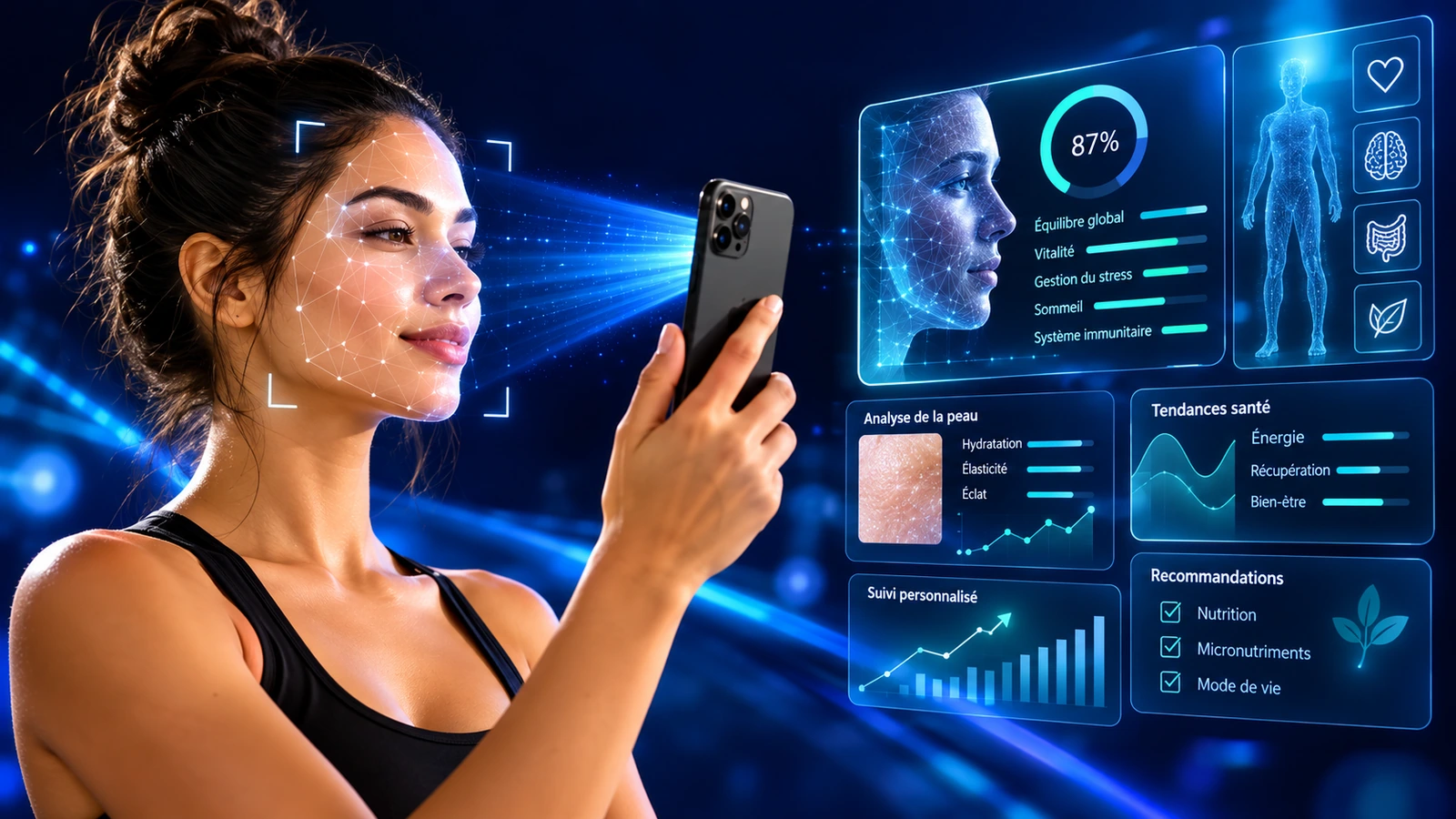
A scan using your phone camera
The principle is surprisingly simple. You look into the phone camera and remain still for a short time. The system analyses tiny changes in skin colour linked to the flow of blood with each heartbeat.
This technology is known as remote photoplethysmography, or rPPG. It can recover a pulse signal from facial video without a wearable sensor, needle or blood-pressure cuff.
Vital Health describes the scan as taking about 30 seconds. In practical terms, the phone can provide several wellness reference points in under a minute.
What can the scan genuinely add?
The strongest evidence for rPPG is around measures such as heart rate, heart-rate variability (HRV) and respiratory rate.
The app also displays other wellness indicators related to areas such as stress, recovery and broader trends. Not every indicator has the same level of scientific validation.
An important distinction:
Vital Health itself describes some measures as more established than others. Blood oxygen is still presented as emerging, while camera-based blood-pressure estimation is described as experimental.
What interests me most: the trend
For me, the most useful part is not a single number from one scan. One result is only a snapshot of one moment.
Repeating the scan over time is more interesting: you can begin to notice what stays stable, what changes and what seems to move alongside sleep, stress, activity or other habits.
Comparing scans also works better under reasonably similar conditions. Lighting, movement and camera quality can affect readings.
Want to try your first scan?
You can open the scanner directly and explore the reference points it provides for yourself.
Take my facial scan The scan is a wellness and observation tool. It does not replace a diagnosis, a medical examination or advice from a qualified healthcare professional.What the scanner should not be asked to tell us
An unusual result does not automatically mean that a health problem is present. Likewise, a favourable-looking result cannot guarantee that everything is fine.
Vital Health presents its face scan as a wellness tool for following trends. The Vital Health Scan itself is not presented as a medical device authorised to diagnose or treat disease.
Keeping this boundary clear makes the tool more useful, because we can benefit from the information without asking it to provide answers it was not designed to give.
Why this fits naturally with Ancrage Global
This approach follows the same progression as the previous articles.
The scan does not replace what we feel or the judgement of a professional. It simply adds another piece to the puzzle.
The facial scan is not there to tell us what disease we have. Its value is in giving us additional reference points for observing change over time.
Key takeaway
The technology is fascinating, but its value depends mainly on how we use it. A single result needs perspective. A trend followed over time can become much more informative.
See the scanner in practice
The simplest way to understand it is to try it and look at the results with curiosity rather than trying to interpret everything immediately.
Take my facial scanWhat comes next?
In the next article, I will show how I personally look at a scan result: which indicators I check first, which ones I keep in the background and why trying to correct everything at once is rarely useful.
Sources and further reading
- Vital Health Scan — how the scan works
- Vital Health Scan — rPPG science and limitations
Continue exploring
Explore more articles
Move through the Ancrage Global articles in their reading order.


Your feedback matters
Was this article helpful?
Your feedback helps me prepare future Ancrage Global content.
💚 0 readers found this article helpful
A question or an experience to share? Write to me
Continue the journey
Did this article resonate with you?
Do you have a question, an experience to share or a topic you would like me to explore? I will be happy to talk with you.